
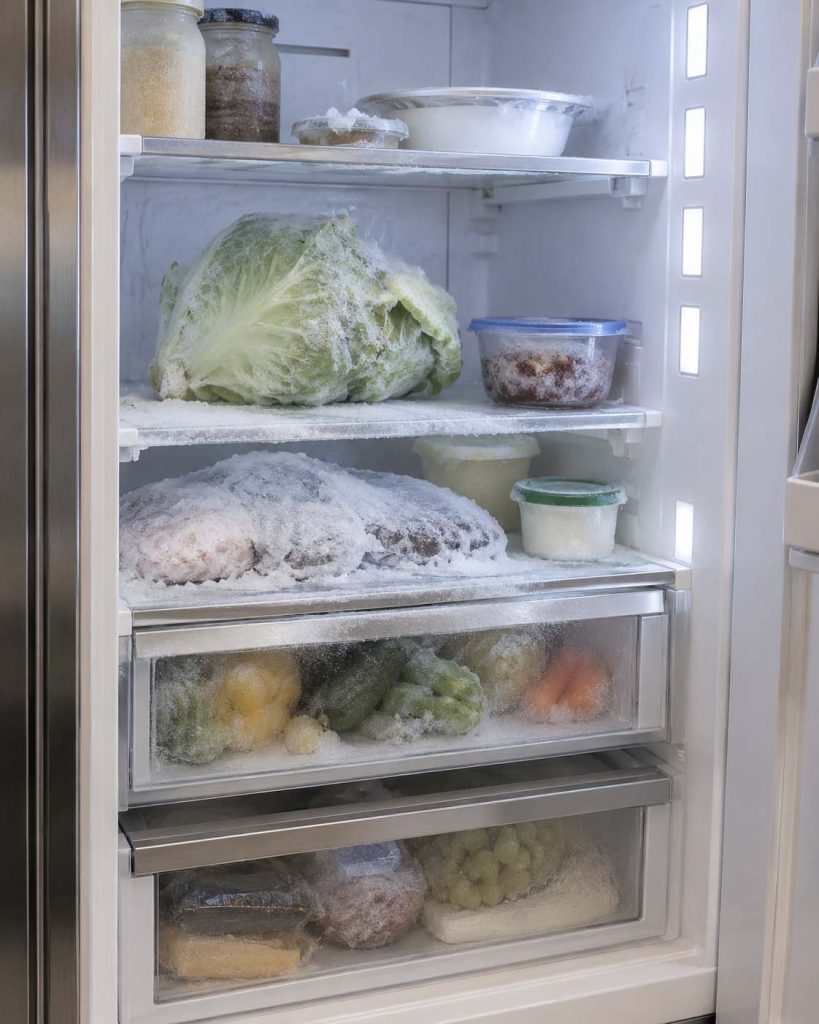
A Sub-Zero refrigerator freezes food when cold freezer air reaches the fresh-food section unchecked. The usual causes are a wrong temperature setting, food blocking the air vents, a stuck air damper, or a failed thermistor or control board. Adjust the setting first, then move food away from the vents.
A Sub-Zero refrigerator holds a tight, steady temperature for decades. So frozen lettuce or ice-crusted milk is a real fault, not a quirk.
Sub-Zero built-ins use a dual-compressor design. Freezer air is routed into the fresh-food side through a controlled damper. When that control drifts, produce freezes fast.
This guide from our factory-certified technicians shows which part is to blame. You will learn the checks you can safely do yourself, and the point where a Sub-Zero refrigerator repair pro should take over.
Book a fix now: Food freezing and you can’t find the cause? Schedule a certified Sub-Zero refrigerator repair visit for a same-day diagnosis backed by a written warranty.
How a Sub-Zero refrigerator freezes food
Sub-Zero refrigerators use two sealed systems. One compressor runs the freezer, the other runs the fresh-food section.
Cold air still moves between them through an air damper that opens and closes on a schedule. The fresh-food section is built to hold about 38°F. The freezer holds 0°F.
When too much 0°F air leaks into the fresh-food side, items nearest the vents freeze first. Lettuce, berries, eggs, and milk are the usual casualties.
So a fridge that freezes food is usually a control problem, not a cooling problem. The cold is working — it is simply reaching the wrong compartment.
Match the symptom to the cause
Because Sub-Zero splits cooling and airflow across parts, the pattern you see points to the failing one. Use this table to narrow it down before you open any panels.
| What you notice | Likely cause |
|---|---|
| Food freezes only near the back vents | Food placed against the airflow, or set point slightly low |
| Whole fresh-food section too cold | Temperature setting or main control board |
| Freezing started right after a settings change | Set point too low — adjust and wait 24 hours |
| Freezing plus a Service or Service Soon light | Stored fault logged on the control board |
| One shelf frosts over while others are fine | Air damper stuck open |
| Fridge freezes food and runs almost constantly | Thermistor (temperature sensor) reading wrong |
How to stop your Sub-Zero from freezing food
Work through these steps in order. The first two solve many cases with no repair at all.
Step 1 — Check and correct the temperature setting
Start at the control panel. Sub-Zero recommends 38°F for the fresh-food section and 0°F for the freezer.
Owners often set the fridge to 34–36°F to keep food colder. That pushes produce near the vents below freezing. Reset it to 38°F.
Give the refrigerator a full 24 hours to settle before you judge the result. One degree makes a real difference near the vents.
Step 2 — Move food away from the air vents
Cold air enters the fresh-food section through vents on the back wall. Items pressed against those vents freeze first.
Keep produce, eggs, and drinks a few inches clear of the back wall. Store water-heavy items on the door or middle shelves.
This simple change fixes a surprising share of freezing complaints on its own.
Step 3 — Inspect the air damper
The air damper is a small motorized door. It controls how much freezer air enters the fridge. If it sticks open, cold air floods the fresh-food side.
Open the fresh-food section and find the damper housing on the back or side wall. Feel for airflow that never seems to stop.
A damper stuck open, or a broken damper motor, keeps freezing food no matter how you set the temperature. This part needs a technician to test and replace.
Step 4 — Consider the thermistor
A thermistor is the sensor that tells the control board how cold each section is. When it drifts, the board acts on bad data.
A failed fresh-food thermistor often reads too warm. So the system keeps sending cold air and freezes everything in reach.
Testing a thermistor needs a meter and the correct resistance chart for your model. This step is best left to a Sub-Zero technician.
Step 5 — Don’t guess on the control board
If the setting, food placement, damper, and thermistor all check out, the main control board is the likely cause.
The board on a Sub-Zero is matched to your model by serial number. It is not a trial-and-error swap. A wrong part or a missed calibration leaves the fault in place.
A Service or Service Soon light points here too. The board has logged a code a technician can read.
A quick safety note
Always unplug the refrigerator, or switch off its dedicated breaker, before you reach behind panels or near the fan.
Never chip at frost or ice with a knife or screwdriver. You can puncture a cooling line and turn a small fault into a sealed-system repair.
Leave any refrigerant, wiring, or sealed-system work to an EPA-certified Sub-Zero technician.
When to call a Sub-Zero refrigerator repair pro
Once you have corrected the setting and cleared the vents, the remaining causes need a meter, factory parts, and Sub-Zero training. That means a stuck damper, a failed thermistor, or a faulty control board.
The parts are matched to your model by serial number. A botched repair can void the residual sealed-system warranty. Sub-Zero residential units carry a 12-year limited warranty on the sealed system.
Sub-Zero Appliance Repair works on every model — Classic Built-In (BI-36, BI-42, BI-48), 600 and 700 Series, Designer, and Pro 48. We read the stored codes, isolate the exact part, and back the work with a written warranty across every service area we cover.
How to keep your Sub-Zero from freezing food again
A few habits keep the fresh-food controls working the way Sub-Zero designed them. They also protect the wider cooling system.
- Keep the fresh-food setting at 38°F and resist the urge to run it colder.
- Store water-heavy items away from the back vents, on the door or middle shelves.
- Vacuum the condenser grille every 6 months — every 3 months in homes with pets.
- Check the door gaskets twice a year, since a leaky seal makes the compressor overwork.
These same steps prevent other faults too. If your problem is the opposite — the whole cabinet is warm — read our guide on a Sub-Zero refrigerator not cooling.
If it is the freezer side that struggles instead, see Sub-Zero freezer not cold enough for the defrost and frost checks that apply there.
Frequently Asked Questions
Why is my Sub-Zero refrigerator freezing food in the fresh-food section?
Cold freezer air is reaching the fresh-food side unchecked. The common causes are a temperature setting that is too low, food pressed against the back vents, a stuck air damper, or a failed thermistor. Start by resetting the fridge to 38°F and moving food off the vents, then call a technician if freezing continues.
What temperature should a Sub-Zero refrigerator be set to?
Sub-Zero recommends 38°F for the fresh-food section and 0°F for the freezer. Settings below 38°F push produce and drinks near the vents below freezing. After any change, give the refrigerator a full 24 hours to settle before judging whether the problem is fixed — the system needs time to stabilize.
Can a bad air damper make a Sub-Zero refrigerator freeze food?
A stuck or broken air damper is one of the top causes. The damper is a motorized door that controls how much freezer air enters the fresh-food section. When it sticks open, cold air floods the fridge and freezes food no matter how you set the temperature. A technician can test and replace it.
Why is my Sub-Zero freezing food but the freezer feels fine?
That pattern points to the fresh-food controls, not the freezer system. A too-low setting, a stuck damper, or a faulty fresh-food thermistor lets 0°F air over-cool the fridge while the freezer works normally. Because Sub-Zero uses separate systems, one side can misbehave while the other holds steady. A technician can isolate the exact part.
Is it worth repairing a Sub-Zero refrigerator that keeps freezing food?
In almost every case, yes. Sub-Zero built-ins routinely run 20 years or more, and the cabinet alone can cost $8,000–$15,000 to replace. A damper, thermistor, or control board repair is a small fraction of that. Fixing the fault also protects the food you store and the refrigerator’s long-term reliability.
Keep your Sub-Zero running for decades
A Sub-Zero that freezes food is almost always fixable. The fix protects a refrigerator that can run 20 years or more.
Start with the setting and the vents. Those two checks solve many cases in a single day. If food keeps freezing after that, the damper, sensor, or board needs a trained hand.
Don’t risk a costly mistake on a premium built-in. Book a certified Sub-Zero refrigerator repair visit for a same-day diagnosis, genuine parts, and a written warranty. Call (855) 340-1313 or contact us online to schedule.