
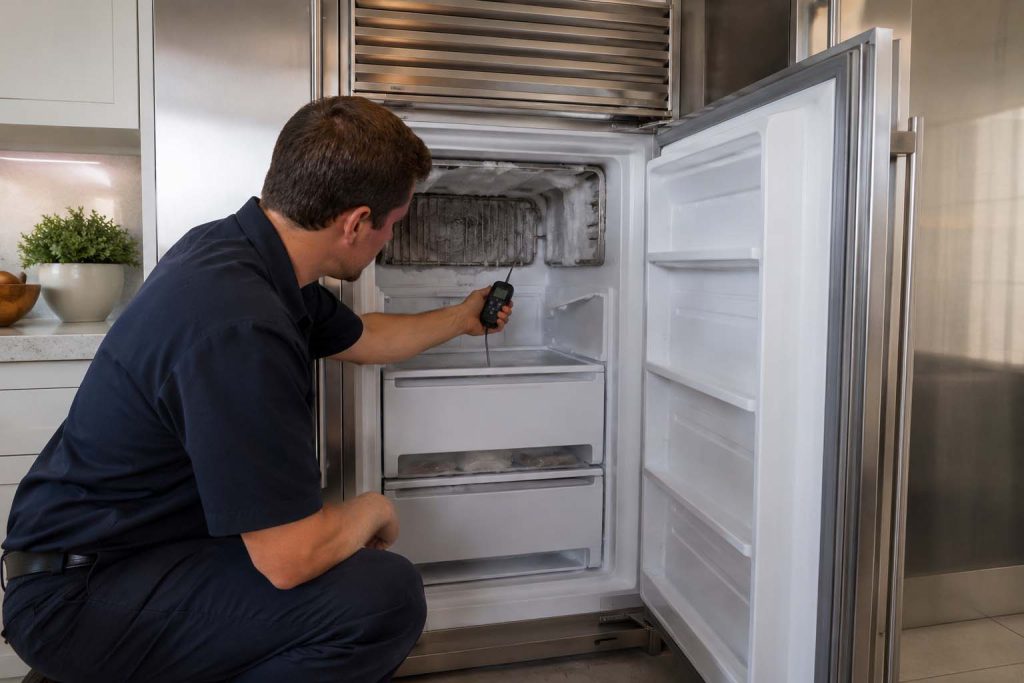
Quick answer: A Sub-Zero freezer that isn’t cold enough is most often caused by dirty condenser coils, a defrost system fault causing frost buildup on the evaporator, a worn door gasket, or blocked air vents. Start by cleaning the condenser, checking the door seal, and confirming vents aren’t blocked. If frost is coating the back wall or the freezer still won’t hold 0°F after those checks, the defrost system, evaporator fan, or sealed system needs a certified technician.
A Sub-Zero freezer is engineered to hold a steady 0°F (-18°C), and its dual refrigeration system runs the freezer on its own dedicated compressor — separate from the refrigerator. That’s why your fridge side can feel perfectly cold while the freezer slowly warms, thaws ice cream, or cakes over with frost. Below, a certified Sub-Zero specialist walks through the real causes in the order we check them on a service call, what you can safely fix yourself, and where the DIY line is.
How cold should a Sub-Zero freezer be?
A properly working Sub-Zero freezer holds 0°F (-18°C). If your display reads higher, or food is soft, partially thawed, or refreezing with freezer burn, the unit is not reaching temperature. Because Sub-Zero uses independent cooling for each compartment, a warm freezer with a cold refrigerator points to a freezer-specific fault — not a whole-unit failure. (If the whole appliance is warm, see our guide on a Sub-Zero refrigerator not cooling.)
Common causes and how to fix them
1. Dirty condenser coils (the #1 cause)
On built-in Sub-Zero units the condenser sits behind the grille at the top of the unit, and it clogs with dust, pet hair, and grease. A choked condenser can’t shed heat, so the compressor runs longer and the freezer loses temperature. Sub-Zero recommends cleaning the condenser every 6 to 12 months — most homes we service have gone years.
Fix it:
- Unplug the unit or switch off the breaker.
- Remove the grille at the top (usually clips or a few screws).
- Vacuum the coils, then brush them with a soft appliance-coil brush.
- Vacuum surrounding dust, reattach the grille, and restore power.
Safety callout: Always disconnect power before reaching behind the grille. The condenser fan can cycle on automatically.
2. Frost or ice buildup (defrost system fault)
If the back wall of the freezer is coated in frost or a sheet of ice, the automatic defrost system likely failed. A bad defrost heater, defrost thermostat, or control board lets frost build on the evaporator coil until airflow chokes off and the compartment warms — the most common reason a Sub-Zero freezer is not cold enough but still frosting.
What you can do: Manually defrost by emptying the freezer, unplugging it, and letting the ice melt for 24 hours with the door open (towels down for water). If frost returns within days, the defrost components need diagnosis — that’s a technician job, not a DIY part swap.
Safety callout: Never chip ice off the evaporator or coils with a knife or screwdriver. Puncturing a coil releases refrigerant and turns a routine repair into a sealed-system replacement.
3. Worn or dirty door gasket
The magnetic gasket seals cold air in. If it’s cracked, stretched, or gummed with residue, humid room air leaks in — the freezer works harder, frosts up, and still runs warm. Test it by closing the door on a dollar bill; if it slides out with no resistance, the seal is failing.
Fix it: Clean the gasket with warm soapy water and check the fit all around. A gasket that’s torn or permanently deformed should be replaced with the OEM part for your model.
4. Blocked vents or an overpacked freezer
Sub-Zero moves cold air through vents between the compartments. Boxes shoved against the back wall or an overstuffed freezer block that airflow, creating warm spots even when the system is healthy.
Fix it: Leave a couple of inches of clearance around the rear and side vents and avoid packing the freezer wall-to-wall.
5. Failed evaporator fan motor
The evaporator fan pushes cold air across the coil and into the compartment. If you don’t hear it running, or it’s noisy and intermittent, the freezer won’t cool evenly no matter how well the compressor works. Fan motor replacement is a technician repair.
6. Faulty temperature sensor or control board
Sub-Zero units rely on thermistors and a control board to read temperature and trigger cooling. A failed sensor reports the wrong temperature, so the system under-cools or short-cycles. This shows up as erratic temperatures or an error code or service light on the display and requires diagnostic tools to confirm.
7. Sealed system or compressor problem (pro only)
If the coils are clean, the door seals, the fan runs, and the freezer still won’t reach 0°F, the sealed refrigeration system — refrigerant charge, compressor, or a leak — is the likely cause. This is never a DIY repair: sealed-system work is EPA-regulated and requires a licensed technician.
Try a Sub-Zero freezer reset first
Before assuming the worst, a reset clears control-board glitches after a power event:
- Turn the unit off at the control panel.
- Unplug it or switch off the breaker for 2 to 5 minutes.
- Restore power and set the freezer to 0°F.
- Allow 24 hours to fully recover temperature before judging the result.
If it drifts warm again after a full day, the problem is mechanical, not a glitch.
Repair cost and when to call a pro
Simple maintenance — cleaning the condenser, swapping a gasket — is well within DIY range and costs little more than your time. Where the value of a specialist shows is in defrost-system faults, evaporator fan motors, control boards, and anything involving the sealed system, where misdiagnosis is expensive and refrigerant work is legally restricted. For a full breakdown of typical repair pricing, see our Sub-Zero refrigerator repair cost guide.
Call a certified technician if: frost keeps returning after a manual defrost, the evaporator fan is silent, the display shows an error, or the freezer won’t hold 0°F after a clean condenser and a good door seal. Our team handles professional Sub-Zero freezer repair with OEM parts and factory diagnostics. Only losing the freezer while the fridge stays cold? That specific pattern is covered in our guide to a Sub-Zero freezer not working but the refrigerator is.
Book a repair:Contact us or call (855) 340-1313 for certified Sub-Zero service.
Frequently asked questions
Why is my Sub-Zero freezer not cold enough but the refrigerator is fine? Sub-Zero’s dual refrigeration runs the freezer on its own compressor, so a freezer-only fault — dirty condenser, defrost failure, or a bad evaporator fan — leaves the refrigerator unaffected. Start with the condenser and door seal, then have the defrost system checked.
How do I fix frost buildup in my Sub-Zero freezer? Manually defrost the unit for 24 hours to clear the ice, and check that the door gasket seals fully. If frost returns within a few days, the defrost heater or thermostat has failed and needs a certified technician — do not chip at the ice.
What temperature should a Sub-Zero freezer be set to? 0°F (-18°C). If food is soft or refreezing with freezer burn, the unit isn’t holding temperature and should be diagnosed.
Will resetting my Sub-Zero freezer fix it? A reset (power off for 2–5 minutes, then allow 24 hours to recover) can clear a control-board glitch after a power outage. If the freezer drifts warm again after a full day, the cause is mechanical, not electronic.
How often should I clean my Sub-Zero condenser? Every 6 to 12 months. A clogged condenser is the single most common reason a Sub-Zero freezer runs warm, and cleaning it is the easiest preventative fix.