
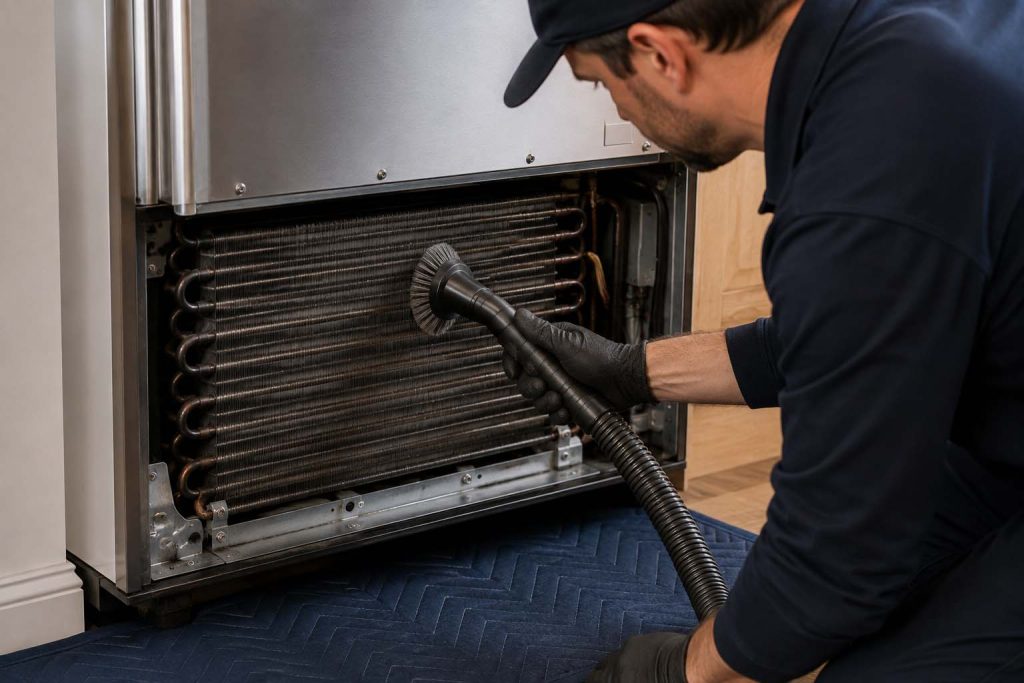
A Sub-Zero refrigerator that runs constantly is usually protecting food temperature, not failing. Dirty condenser coils, a warm room, a full load, or a worn door gasket make the compressor cycle longer than normal. Nonstop running paired with weak cooling points to a failing thermistor, defrost system, or sealed system that needs a factory-certified technician.
This guide covers why a Sub-Zero refrigerator’s compressor keeps running instead of cycling normally, and which fix matches each cause. Sub Zero Appliance Repair provides factory-certified diagnostic and repair service for Sub-Zero refrigeration, freezer, wine cooler, and ice maker systems. You’ll learn which causes you can check yourself, which point to a failing part, and when it’s time to call a certified technician.
Schedule a Sub-Zero refrigerator repair visit for a straight diagnosis of what’s failing.
What “running constantly” means for a Sub-Zero refrigerator
Sub-Zero builds its refrigerators for long duty cycles, so a compressor that runs more than a standard fridge isn’t automatically a fault. Sub-Zero states its products are designed to last about 20 years on average. That durability comes from a refrigeration system built to run long, steady cycles rather than short bursts.
A unit that runs a lot but holds its set temperature is working as designed. The problem starts when running time stops matching results. If the compressor never rests and the interior still drifts warm, you’re looking at a real fault, not a heavy-use pattern.
This distinction matters most for owners deciding whether to worry. A unit within its expected lifespan that’s simply running through a hot week or a full refrigerator is not a red flag.
The most common causes of nonstop compressor cycling
Sub-Zero’s own troubleshooting guidance names a dirty condenser and food loads outside the 25-75% full range as top causes of longer run times. A clogged condenser forces the compressor to work harder to move the same amount of heat. An overloaded unit blocks internal airflow, while a near-empty one has too little thermal mass to hold a steady temperature.
A warm kitchen adds to the load, since the compressor has to fight a bigger gap between room and cabinet temperature. A door gasket that isn’t sealing lets cold air leak out continuously, so the compressor never gets the signal to rest.
The table below matches each cause to what you’d notice and a first check you can run yourself.
| Cause | What you’ll notice | Quick check |
| Dirty condenser | Long cycles, coils warm to the touch | Vacuum the coils behind the grille |
| Overloaded or near-empty unit | Longer cycles after grocery day or in a mostly bare unit | Aim for 25-75% full |
| Warm kitchen | Cycles lengthen in summer or near ovens | Check room temperature near the unit |
| Worn door gasket | Compressor never fully rests | Close a sheet of paper in the door and pull |
If more than one of these matches your unit, work through them in order starting with the condenser.
Component-level causes a technician checks
A Sub-Zero’s compressor is engineered to run within a 60-95°F room temperature range, so a hot kitchen alone can push it into constant operation. Beyond room conditions, technicians check four parts that fail in similar-looking ways. Those are the thermistor, the evaporator or condenser fan motor, the defrost heater assembly, and the sealed system itself.
A failing thermistor reports the wrong temperature, so the control board keeps calling for cooling the compartment doesn’t need. A weak evaporator or condenser fan motor moves less air across the coils, so the compressor runs longer to hit the same temperature. A defrost heater or thermostat that doesn’t fire lets frost build on the evaporator coils, which chokes airflow further.
Why Sub-Zero’s two-compressor design changes this diagnosis
Many Sub-Zero refrigerators use two dedicated compressors and two independent evaporators, one set for the fresh food side and one for the freezer. Sub-Zero describes this design as completely isolating the refrigerator from the freezer, so each side manages its own temperature and humidity. That means one side can run constantly while the other cycles on and off normally.
This changes where a technician looks first. A freezer compressor running nonstop alone points to the freezer side — see our Sub-Zero freezer not cold enough guide. Both compressors running long at once usually means the room, the load, or shared power is the more likely cause.
What you can check yourself before calling for service
Start with the condenser coils, since a dirty coil is the single most common cause and the easiest to rule out. Pull the unit’s grille and vacuum any visible dust or pet hair. Then confirm nearby cabinetry isn’t trapping heat around the unit.
Next, check the door gasket for gaps by closing it on a sheet of paper and pulling gently; it should grip. A Sub-Zero freezer should hold at or below 0°F. Readings above 10°F often coincide with longer compressor run times, per Sub-Zero troubleshooting guides.
Finally, review your food load. A unit that’s nearly empty or packed past the door seals needs a load adjustment before you assume a part has failed.
Built-in and integrated Sub-Zero refrigerators pull air through a vent panel or toe-kick grille rather than the open back of a standalone unit. Furniture, rugs, or renovation debris blocking that vent trap heat around the compressor and add to run time, so clear it along with the coils.
- Clean the condenser coils behind the grille
- Run the paper test on every door gasket
- Confirm freezer temperature is at or below 0°F
- Adjust food load toward the 25-75% full range
- Clear the built-in vent panel or toe-kick grille
When to call a certified Sub-Zero technician
Call for service if the compressor runs nonstop for more than a day after basic checks. That means after you’ve cleaned the coils, adjusted the load, and confirmed the door seals. That pattern points to a component failure rather than normal duty cycling.
A certified visit starts with the same checks above: coils, gaskets, freezer temperature, and food load. If those come back clean, the technician measures compressor amp draw and sealed-system pressures to confirm which part is failing before ordering parts.
Sub-Zero designs its units to last about 20 years on average. A unit well under that age running nonstop is usually a single-part fix, not a reason to replace it.
Our Sub-Zero refrigerator repair cost guide breaks down what parts and labor typically run once a technician confirms the cause. If your unit has stopped holding temperature entirely instead of just running long, see our guide to a Sub-Zero refrigerator not cooling.
Frequently asked questions
Why does my Sub-Zero refrigerator run constantly even when it feels cold inside?
A Sub-Zero refrigerator can run constantly while still keeping food cold, and that alone doesn’t mean it’s broken. The compressor works overtime to compensate for a dirty condenser, a warm kitchen, or a door that isn’t sealing tightly. Cleaning the coils and checking the gasket resolves this cause in many cases.
How long should a Sub-Zero refrigerator’s compressor run per cycle?
A Sub-Zero compressor runs longer per cycle than a standard refrigerator, since it’s engineered for a 60-95°F room range and long, steady cycles. There’s no fixed number of minutes that applies to every model and load. The pattern that matters is whether the compressor ever fully rests, not the length of a single cycle.
Can a worn door gasket make a Sub-Zero refrigerator run nonstop?
Yes, a worn or misaligned door gasket is one of the most common reasons a Sub-Zero refrigerator won’t stop running. A gap in the seal lets cold air leak out continuously, so the compressor never reaches its shutoff point. The paper test at the door edge is a quick way to check it yourself.
Should I unplug a Sub-Zero refrigerator that won’t stop running?
No, unplugging a Sub-Zero refrigerator that’s running constantly can let stored food spoil before you’ve identified the cause. It’s safer to check the condenser coils, door seals, and food load first, then schedule a diagnostic visit if the unit still won’t cycle off. Only disconnect power if you notice burning smells or exposed wiring.
How do I know if my Sub-Zero refrigerator’s compressor is failing?
A failing Sub-Zero compressor usually runs constantly while cooling performance keeps declining and the hum grows noticeably louder over time. Cleaned coils, a good door seal, and a reasonable food load rule out the simpler causes and point toward the sealed system. A factory-certified technician can confirm this with pressure and amperage readings.
Does a Sub-Zero refrigerator running constantly cost more to operate?
Yes, a compressor that runs too much uses more electricity, even if it’s hard to spot on one monthly bill. The bigger risk is wear on the compressor and fan motors from running for extended periods without rest. Fixing the underlying cause protects both your energy use and the appliance’s parts.
Conclusion
Most Sub-Zero refrigerators that run constantly are still doing their job within their roughly 20-year design life. They’re just working harder because of a dirty condenser, a warm room, or a food load outside the ideal range. Nonstop running paired with warming temperatures is different, and that combination points to a thermistor, fan, defrost, or sealed-system fault that needs a factory-certified technician.
Clean the coils and check the door seal first. Schedule a Sub-Zero refrigerator repair visit if the pattern doesn’t change within a day or two, or browse our Sub-Zero repair guides for other symptoms.